
Part 1Short version
A first test
The two broadest patterns in the cosmic microwave background (CMB), the quadrupole and the octupole, point in nearly the same direction. A SkyMap test found that about 12 masses beyond our horizon, roughly 2% of the observable universe’s matter, can reproduce that pattern with ordinary gravity. It fits 12 masses to 12 numbers, so it shows the idea can work, not that it is confirmed. The same masses predict a supernova signal about 1,000 times too faint for today’s surveys to detect.
Why it looks round
We sit inside a sphere of last scattering, the shell the CMB’s light set out from, so we see out to the same distance in every direction. The masses beyond it don’t need to be spread evenly. Their pulls differ by distance and angle, and together they smooth the net force into a sphere. Direction cancels; magnitude doesn’t have to.
Further out, faster
EGC proposes that the net-zero point is at us, in our own galaxy. The further a galaxy is from us, the stronger the differential pull and the faster it accelerates, the pattern seen in the redshift data. A detailed fit is still to be done.
The Hubble tension
Early-universe and later-universe measurements of the expansion rate disagree, a gap known as the Hubble tension. In the standard model, Lambda CDM, that is a contradiction. In EGC it is what you would expect: gravitational fields vary from place to place, so galaxies move by different amounts depending on where they sit and what is pulling on them. Lambda CDM also struggles with galaxies in the early universe that look too massive for their age, and with the lithium problem, where the oldest stars hold less lithium than it predicts.
Still open
Masses beyond our view may collapse or merge over cosmic time, shifting their pull. The proposed answer is the same smoothing, which should keep the field steady, but whether it gives the size of unevenness we see in the CMB still needs checking.
In EGC discussion, “right” means the best current fit, not proven.
Part 2Long version: the full discussion
Why does the observable universe look round, how can it stay round when the matter beyond it is spread unevenly, and what does that mean for the expansion rate? These notes write up a discussion from October 3, 2026, and follow its nine points in order. External Gravity Cosmology (EGC) proposes that the acceleration we see is a pull from masses beyond our view, not a push from inside.
1. A first test: a dozen masses and the CMB
The cosmic microwave background (CMB) is the faint glow left from the early universe, and it fills the whole sky. On its largest scales it has an odd pattern. Its two broadest patterns, known as the quadrupole and the octupole, point in nearly the same direction. Planck’s own analysis put the chance of an alignment that close at about 1 in 100.
The SkyMap test asked whether masses beyond our horizon, pulling with ordinary Newtonian gravity and no new physics, could produce that pattern. It found that 12 masses can. Placed at about twice the radius of the observable universe, they total about 9 × 10²¹ times the mass of the Sun, roughly 2% of the matter in the observable universe. They reproduce the quadrupole and the octupole and add almost nothing to the next, finer pattern, so the rest of the map is left as it is.
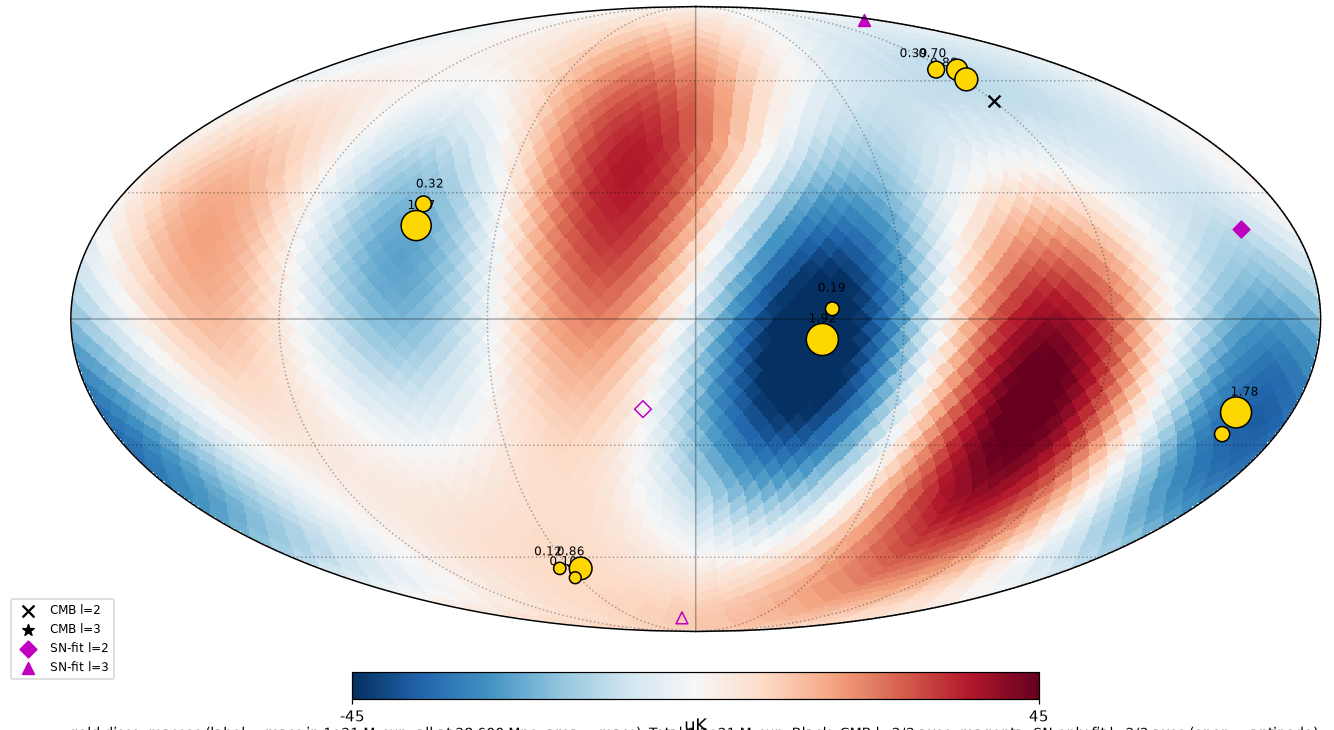
That shows the pattern can be produced this way. It does not confirm EGC: the test fits 12 adjustable numbers to 12 measured ones. The arrangement is not unique either. Other arrangements with the same broad shape fit equally well, and masses placed closer in would need less total mass, while masses further out would need more.
The same 12 masses also predict a direction-dependent shift in supernova distances about 1,000 times smaller than today’s best supernova survey, Pantheon+, can detect. Pantheon+ shows no significant pattern at these scales, which fits that prediction. It also sets a limit: an outside field strong enough to show up in today’s supernova data would make the CMB pattern far stronger than Planck measures. Better routes to a test are measurements tied to the same pull: the polarization of the CMB on the largest scales, CMB light scattered by distant galaxy clusters, and matching the CMB pattern against maps of galaxies along the same axes.
2. Why the observable universe looks round
We sit inside a sphere of last scattering. That is the shell the CMB’s light set out from, when the early universe first became clear enough for light to travel freely, and that light has been on its way to us ever since. Look in any direction and we see out to that same distance, so the observable universe appears round. The roundness comes from where we stand, not from an edge in the universe itself.
3. Uneven masses, a smooth sphere
The masses beyond that sphere do not need to be spread evenly. Each pulls with a strength that depends on its size, its distance and its direction from us, so the pulls differ from place to place. Together these differential pulls smooth the net force into a sphere, even when the masses are bigger in some directions than in others. Direction cancels; magnitude doesn’t have to.
4. Net zero at us, faster further out
Where do all those pulls balance? EGC proposes that the net-zero point is at us, in our own galaxy. A galaxy away from that centre feels a net tug, and the further it is from us, the stronger the differential pull and the faster it accelerates. That is the pattern in the redshift data, where more distant galaxies are moving away faster. A detailed fit of the model’s pull to those data has not been run yet.
5. The Hubble tension, reframed
The Hubble constant is the rate the universe is expanding today. Worked out from the early universe, through the CMB, it comes out at about 67 kilometres per second per megaparsec. Measured in the nearer, later universe, using supernovae and pulsating stars, it comes out at about 73. The two results no longer overlap within their error bars, and in the standard model the gap is a contradiction, known as the Hubble tension.
EGC reads it differently. Gravitational fields vary from place to place, so galaxies move by different amounts depending on where they sit and what is pulling on them. Measurements taken in different ways, from different parts of the universe, would then be expected to give different numbers. On that reading the gap is what the model expects, not a contradiction.
6. Varying fields, varied movement
In this model the Hubble tension is resolved by the same gravity that drives everything else: no single expansion rate has to hold everywhere, because the pull is not the same everywhere. This is EGC’s claim, and it still has to be shown with a calculation that reproduces both values from the fields involved.
7. Where Lambda CDM struggles
Lambda CDM (ΛCDM) is the standard model of cosmology: a universe driven apart by dark energy (Λ) and held together by cold dark matter (CDM). It does not fit the data on its own. Three problems stand out:
- the Hubble tension, above;
- galaxies in the early universe, seen by the James Webb Space Telescope, that look too massive and too mature for their age;
- the lithium problem: the oldest stars hold about three times less lithium than the standard account of the early universe predicts.
8. Open question: can the outside field stay still?
Over cosmic time, masses beyond our view may collapse or merge, and that would shift their pull. Can the external field then be treated as static? The proposed answer is the smoothing in point 3: because the net pull is smoothed into a sphere, it should hold steady even as individual masses change.
The size of the effect still needs checking. The SkyMap test tried two ways of handling time, one with the masses held in place and one with the pattern carried along with the expansion, and how strongly the CMB pattern comes out changed by a factor of 4 to 28 between them. Whether a field that changes over time gives the size of unevenness we actually see in the CMB is still to be worked out.
9. A note on wording
In EGC discussion, “right” means the best current fit, not proven. That applies to everything on this page.